
AV-over-IP vs Traditional Matrix Switching: Which One Should You Choose?
Understanding the Differences Between Modern AV Networks and Traditional Video Distribution Systems
Introduction
For years, matrix switchers were the backbone of professional AV systems.
Whether it was a boardroom, training center, auditorium, or command center, matrix switchers allowed users to route multiple sources to multiple displays.
Today, however, a new technology is rapidly changing the AV landscape:
🌐 AV-over-IP (AVoIP)
As organizations demand greater scalability, flexibility, and remote management, AV-over-IP is becoming the preferred choice for modern AV deployments.
But does that mean matrix switchers are obsolete?
Let’s compare both technologies and understand where each solution fits.
What is a Matrix Switcher?
A matrix switcher is a hardware device that routes audio and video signals from multiple inputs to multiple outputs.
Example
An 8×8 Matrix Switcher allows:
- 8 Inputs
- 8 Outputs
Any source can be displayed on any screen.
Typical Signal Flow
Laptop
Blu-ray
Camera
     ↓
Matrix Switcher
     ↓
Display 1
Display 2
Display 3
Benefits of Matrix Switching
Simple Architecture
Easy to understand and deploy.
Low Latency
Near-instant signal switching.
Reliable Performance
Minimal network dependencies.
Ideal for Small Installations
Works well for:
- Boardrooms
- Training Rooms
- Classrooms
Limitations of Matrix Switchers
As systems grow, challenges appear.
Fixed Capacity
Examples:
- 8×8
- 16×16
- 32×32
Expanding often requires replacing hardware.
Distance Limitations
HDMI and traditional AV cabling have distance constraints.
Complex Cabling
More endpoints require more dedicated cables.
Limited Flexibility
Scaling across multiple floors or buildings can be difficult.
What is AV-over-IP?
AV-over-IP transmits:
- Video
- Audio
- USB
- Control Signals
Across standard Ethernet networks.
Instead of a central matrix switcher, AV signals travel through network switches using encoders and decoders.
Typical Signal Flow
Source
   ↓
Encoder
   ↓
Network Switch
   ↓
Decoder
   ↓
Display
Benefits of AV-over-IP
Unlimited Scalability
Add:
- More Encoders
- More Decoders
- More Displays
Without replacing the entire system.
Flexible Routing
Any source can be routed to any display across the network.
Reduced Cabling
Leverages existing network infrastructure.
Centralized Management
Monitor and manage devices remotely.
Easier Expansion
New endpoints can be added with minimal disruption.
Matrix Switching vs AV-over-IP
| Feature | Matrix Switching | AV-over-IP |
|---|---|---|
| Scalability | Limited | Excellent |
| Distance | Limited | Very Long |
| Flexibility | Moderate | High |
| Expansion | Difficult | Easy |
| Cabling | Dedicated AV Cabling | Ethernet |
| Centralized Management | Limited | Advanced |
| Initial Complexity | Lower | Higher |
| Future-Proofing | Limited | Excellent |
When Matrix Switchers Make Sense
Matrix systems are still valuable for:
Small Boardrooms
Simple source-to-display routing.
Single-Room Installations
Limited endpoints.
Budget-Conscious Projects
Lower upfront cost.
Basic AV Environments
No need for advanced network functionality.
When AV-over-IP Makes Sense
AV-over-IP excels in:
Enterprise Offices
Multiple meeting rooms and displays.
Universities
Campus-wide content distribution.
Control Rooms
Large-scale video routing.
Digital Signage Networks
Centralized content management.
Large Conference Centers
Scalable AV infrastructure.
Network Requirements for AV-over-IP
Unlike matrix switchers, AV-over-IP relies on networking best practices.
Key considerations include:
VLANs
Separate AV traffic from data traffic.
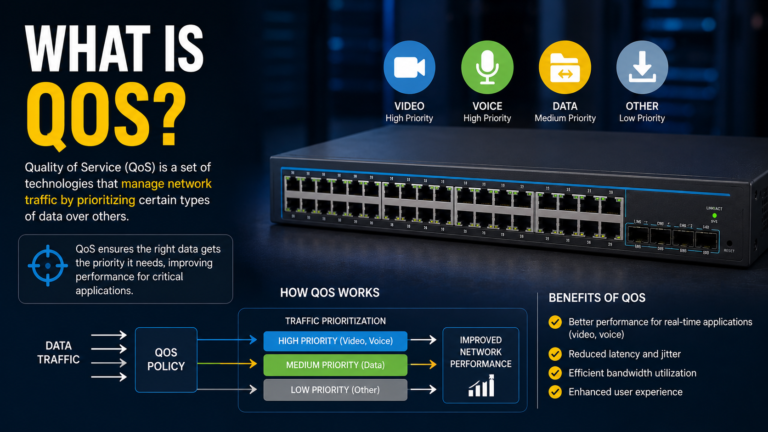
QoS
Prioritize video and audio streams.
IGMP Snooping
Control multicast traffic efficiently.
Bandwidth Planning
Ensure adequate network capacity.
Common AV-over-IP Technologies
Popular technologies include:
NDI
Ideal for corporate AV and streaming.
SDVoE
High-performance, low-latency video distribution.
Dante AV
Combines audio and video over IP networks.
Crestron NVX
Enterprise-grade AV-over-IP platform.
Cost Comparison
Matrix Switchers
Lower initial investment.
Higher upgrade costs as systems grow.
AV-over-IP
Higher initial planning effort.
Lower long-term expansion costs.
Better scalability.
Future of Professional AV
Industry trends clearly show movement toward:
✅ AV-over-IP
✅ Network-Based AV
✅ Cloud Management
✅ Remote Monitoring
✅ Enterprise Collaboration
While matrix switchers remain useful in smaller projects, most new enterprise deployments are adopting AV-over-IP architectures.
Which One Should You Choose?
Choose Matrix Switching If:
✅ Small room deployment
✅ Limited endpoints
✅ Simple routing requirements
✅ Tight budget
Choose AV-over-IP If:
✅ Large-scale deployment
✅ Multiple rooms
✅ Future expansion planned
✅ Enterprise environment
✅ Centralized management required
Conclusion
Both matrix switchers and AV-over-IP have their place in modern AV systems.
Matrix switchers remain a reliable option for smaller installations, while AV-over-IP offers the scalability, flexibility, and future-proofing required by modern enterprises.
As AV and IT continue to converge, AV-over-IP is becoming the preferred architecture for organizations looking to build scalable and intelligent AV environments.
Traditional matrix switching connects devices. AV-over-IP connects possibilities.
Key Takeaways
📌 Matrix switchers are ideal for small AV deployments
📌 AV-over-IP provides greater scalability and flexibility
📌 AV-over-IP leverages existing network infrastructure
📌 Matrix systems have fixed input/output limitations
📌 AV-over-IP supports centralized management
📌 Enterprise AV is increasingly moving toward IP-based architectures
📌 Understanding networking is becoming essential for AV professionals
Tags: #AVOverIP #MatrixSwitcher #AVNetworking #EnterpriseAV #ProAV #NDI #DanteAV #SDVoE #CrestronNVX #HybridWork #AVTechnology #AVInsider


One Comment