What is DSP in Audio Visual Systems? A Beginner’s Guide
Introduction
If you’ve worked with conference rooms, auditoriums, classrooms, or meeting spaces, you’ve probably heard the term DSP (Digital Signal Processor).
DSP is one of the most important components in modern Audio Visual (AV) systems. It helps improve audio quality, eliminate echoes, manage microphones, route audio signals, and create a seamless communication experience.
In this guide, we’ll explain what DSP is, how it works, and why it’s essential in professional AV deployments.
What is a DSP?
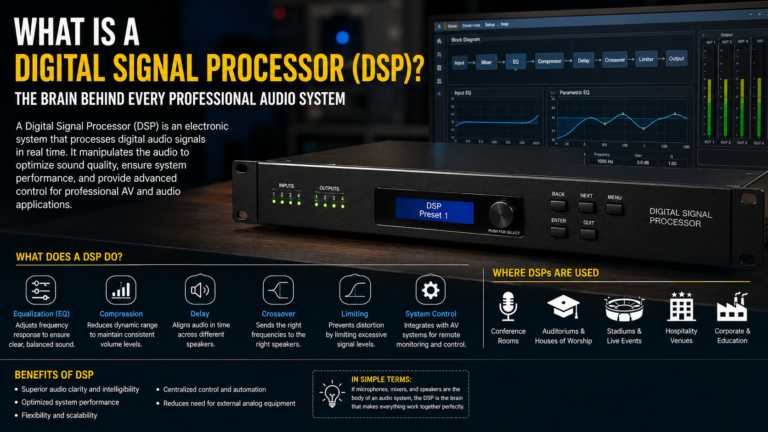
A Digital Signal Processor (DSP) is a specialized device or software that processes audio signals digitally before they reach speakers, recording devices, or conferencing platforms.
Think of a DSP as the “brain” of an AV audio system.
It receives audio from microphones and sources, processes the signal, and sends optimized audio to speakers or conferencing platforms like Microsoft Teams or Zoom.
Why Do AV Systems Need DSP?
Without a DSP, audio systems can experience:
- Echo and feedback
- Uneven microphone levels
- Poor speech intelligibility
- Background noise
- Audio routing limitations
DSP solves these issues by intelligently processing audio in real time.
Key DSP Functions
🎙️ Acoustic Echo Cancellation (AEC)
AEC removes echoes that occur when microphone audio picks up sound from room speakers.
This is especially important in:
- Microsoft Teams Rooms
- Zoom Rooms
- Hybrid meeting spaces
🔊 Equalization (EQ)
EQ adjusts audio frequencies to improve sound quality and speech clarity.
Benefits include:
- Clearer voices
- Reduced room resonance
- Improved listening experience
🎚️ Automatic Gain Control (AGC)
AGC automatically adjusts microphone levels.
Benefits:
- Soft speakers become easier to hear
- Loud speakers don’t overload the system
- Consistent audio quality
🔇 Noise Reduction
DSPs can reduce:
- HVAC noise
- Keyboard typing
- Background conversations
- Environmental sounds
This improves remote meeting experiences significantly.
🔀 Audio Routing and Mixing
DSPs can route audio from multiple sources to different outputs.
Example:
- Wireless microphones
- Laptop audio
- Video conferencing audio
All can be mixed and routed independently.
Where Are DSPs Used?
DSPs are commonly deployed in:
🏢 Corporate Meeting Rooms
- Microsoft Teams Rooms
- Zoom Rooms
- Boardrooms
🎓 Education
- Classrooms
- Lecture halls
- Training rooms
🎭 Auditoriums
- Public speaking
- Events
- Presentations
🏨 Hospitality
- Conference centers
- Ballrooms
- Hotels
Popular DSP Platforms
Some of the most widely used AV DSP solutions include:
- Biamp Tesira
- Q-SYS Core Series
- Shure IntelliMix DSP
- Yamaha MTX Series
- Symetrix DSP
- Extron DSP Processors
DSP and Microsoft Teams Rooms
In Teams Rooms, DSPs play a critical role by:
- Processing microphone audio
- Performing echo cancellation
- Optimizing speech intelligibility
- Integrating multiple audio sources
This ensures a professional hybrid meeting experience.
Benefits of Using DSP
✅ Better audio clarity
✅ Reduced echo and feedback
✅ Improved speech intelligibility
✅ Flexible audio routing
✅ Enhanced conferencing experience
✅ Scalable AV system design
Conclusion
A DSP is one of the most valuable components in any professional AV deployment. Whether you’re designing a boardroom, classroom, or large auditorium, DSP technology helps deliver clear, reliable, and professional audio experiences.
As organizations continue adopting hybrid collaboration and AV-over-IP technologies, DSPs will remain a critical part of modern AV infrastructure.
Key Takeaway
A DSP isn’t just an audio processor—it’s the foundation of high-quality communication and collaboration in modern AV environments.