Why AV Over IP Is Becoming the New Standard for Enterprise AV
The shift from traditional AV infrastructure to network-based systems is changing how organizations design, deploy, and manage technology.
Introduction
Walk into a modern boardroom, university campus, or control room today, and you’ll notice a significant change.
Audio, video, USB, and control signals are no longer confined to dedicated AV infrastructure. Increasingly, they are being transported over the same network that carries business data.
This approach, known as AV Over IP (AVoIP), has evolved from an emerging technology into a preferred architecture for many enterprise deployments.
The reason is simple: organizations need systems that are scalable, flexible, and easier to manage.
The Traditional AV Challenge
For years, AV systems relied on:
- HDMI matrix switchers
- Dedicated AV cabling
- Point-to-point connections
- Fixed input and output capacities
While these solutions worked well, expansion often came with additional hardware, increased complexity, and higher costs.
Adding new rooms, displays, or sources frequently required significant redesign.
What Changes with AV Over IP?
Instead of routing signals through dedicated AV infrastructure, AV Over IP uses standard network technology.
A typical deployment includes:
- Source devices
- AV encoders
- Managed network switches
- AV decoders
- Displays and collaboration endpoints
This architecture allows content to be distributed across multiple locations without the limitations of traditional matrix systems.
Why Organizations Are Adopting AV Over IP
Scalability
One of the biggest advantages of AV Over IP is growth.
Adding additional displays or sources is often as simple as connecting another endpoint to the network.
There is no need to replace an entire switching infrastructure simply because the system has reached capacity.
Flexibility
Any source can be routed to virtually any destination.
Examples include:
- Corporate town hall broadcasts
- Digital signage networks
- Campus-wide content distribution
- Multi-room training environments
Centralized Management
Modern AV platforms allow administrators to:
- Monitor device health
- Push firmware updates
- Configure endpoints remotely
- Receive proactive alerts
This significantly reduces support effort, particularly across large deployments.
The Growing Convergence of AV and IT
Perhaps the most important trend surrounding AV Over IP is not technological—it’s operational.
As AV systems become network-dependent, AV professionals are increasingly working alongside IT teams.
Successful deployments now require understanding of:
- VLANs
- QoS
- Multicast traffic
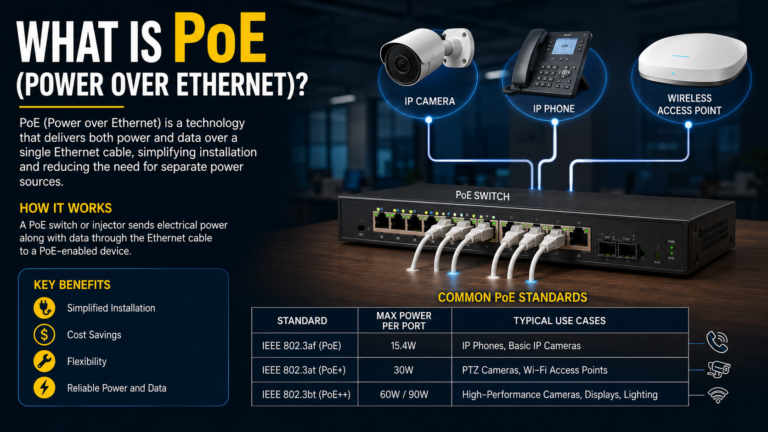
- PoE
- Network security
- Bandwidth management
The most valuable AV engineers in 2026 are those who can confidently operate in both AV and IT environments. Industry analysis continues to highlight AV/IT convergence as a defining trend for enterprise technology deployments.
Technologies Driving the Transition
Several technologies are accelerating AV Over IP adoption:
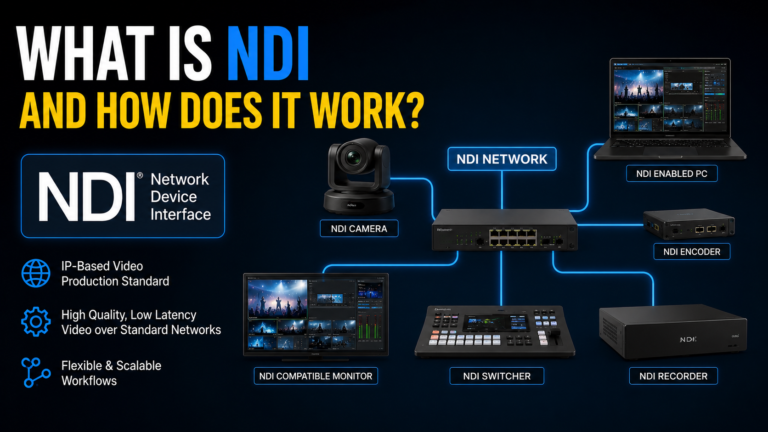
NDI
Widely used in live production, streaming, and hybrid events.
Dante AV
Extends the success of networked audio into video workflows.
SDVoE
Designed for high-performance, low-latency AV distribution.
IPMX
An emerging open standard focused on interoperability across professional AV environments.
Common Deployment Mistakes
Technology alone does not guarantee success.
Some of the most common challenges include:
Insufficient Network Planning
AV traffic can place significant demands on network infrastructure if bandwidth requirements are not properly considered.
Ignoring Multicast Design
Improper switch configuration can result in performance issues and unnecessary traffic.
Lack of Collaboration
Projects often experience delays when AV and IT teams become involved too late in the design process.
Early collaboration consistently leads to smoother deployments and easier long-term support.
Looking Ahead
The future of enterprise AV is increasingly network-centric.
Organizations are already embracing:
- AI-assisted meeting rooms
- Cloud-managed AV systems
- Remote monitoring platforms
- Advanced collaboration environments
- Large-scale AV Over IP deployments
As these technologies mature, the distinction between AV and IT will continue to fade.
Conclusion
AV Over IP is no longer a niche technology reserved for large enterprises.
It is becoming the foundation of modern audiovisual infrastructure.
For organizations planning new meeting spaces, learning environments, control rooms, or digital signage networks, the question is no longer whether to consider AV Over IP.
The question is how quickly they can adopt it.
Key Takeaway
The future of AV is not defined by cables, switchers, or individual devices.
It is defined by networks, scalability, and connected experiences.