Why AV-over-IP is Transforming Enterprise AV in 2026
How IP-Based AV Systems Are Replacing Traditional Matrix Switchers and Reshaping Modern Workspaces
Introduction
The AV industry is undergoing one of its biggest transformations in decades.
Traditional AV systems relied heavily on dedicated cabling, matrix switchers, and point-to-point connections. While these solutions served organizations well for years, modern workplaces demand greater flexibility, scalability, and easier management.
This is where AV-over-IP (AVoIP) comes in.
By leveraging standard network infrastructure, AV-over-IP enables organizations to distribute audio, video, USB, and control signals across a network with unprecedented flexibility.
As hybrid work, smart buildings, and enterprise collaboration continue to evolve, AV-over-IP has become one of the most important trends in professional AV.
What is AV-over-IP?
AV-over-IP is the transmission of audio, video, USB, and control signals over a standard IP network.
Instead of using dedicated AV cabling and large matrix switchers, signals are transmitted through network switches using Ethernet infrastructure.
Traditional AV
Source → Matrix Switcher → Display
AV-over-IP
Source → Encoder → Network Switch → Decoder → Display
This approach creates a highly scalable and flexible AV ecosystem.
Why Organizations Are Moving to AV-over-IP
1. Unlimited Scalability
Traditional matrix switchers have physical limitations.
For example:
- 8×8 Matrix
- 16×16 Matrix
- 32×32 Matrix
Expanding beyond these limits often requires replacing hardware.
With AV-over-IP:
✅ Add more encoders
✅ Add more decoders
✅ Expand network switches
The system grows as your requirements grow.
2. Reduced Infrastructure Costs
Organizations can leverage existing network infrastructure instead of deploying dedicated AV cabling throughout the building.
Benefits include:
- Reduced cabling
- Easier maintenance
- Faster deployment
- Lower expansion costs
3. Flexible Signal Routing
AV-over-IP allows any source to be displayed on any screen.
Examples:
- CEO presentation to multiple meeting rooms
- Digital signage across offices
- Training content distribution
- Emergency messaging systems
This flexibility is difficult and expensive to achieve with traditional AV architectures.
4. Centralized Management
Modern AV-over-IP platforms provide centralized monitoring and control.
Administrators can:
- Monitor devices
- Update firmware
- Diagnose issues
- Configure routing
- Manage users
All from a single interface.
Key Technologies Driving AV-over-IP
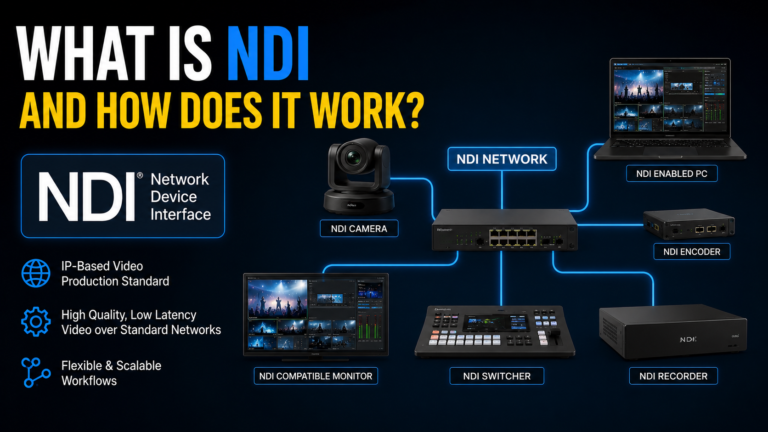
NDI
Network Device Interface (NDI) enables high-quality, low-latency video transport over IP networks.
Popular in:
- Corporate AV
- Broadcast
- Education
- Live Events
SDVoE
Software Defined Video over Ethernet (SDVoE) delivers high-performance AV distribution with near-zero latency.
Ideal for:
- Command Centers
- Control Rooms
- Large Video Walls
Dante AV
Built upon the widely adopted Dante audio ecosystem, Dante AV combines audio and video distribution on a single network.
Benefits include:
- Simplified deployment
- Unified management
- Scalable architecture
AV-over-IP Applications
Corporate Offices
- Boardrooms
- Meeting Rooms
- Collaboration Spaces
Universities
- Lecture Halls
- Distance Learning
- Campus-Wide Content Distribution
Control Rooms
- Security Operations Centers
- Network Monitoring Centers
- Mission-Critical Environments
Digital Signage Networks
- Corporate Communication
- Retail Signage
- Hospitality Displays
Challenges of AV-over-IP
Like any technology, AV-over-IP comes with considerations.
Network Design
Proper network configuration is essential.
Areas to consider:
- VLANs
- QoS
- Multicast Routing
- Bandwidth Planning
IT and AV Convergence
AV professionals increasingly need networking knowledge.
Skills becoming essential:
- Switching
- Routing
- IP Addressing
- Network Security
Bandwidth Requirements
High-resolution content such as:
- 4K
- 8K
- Video Walls
Can consume significant network bandwidth if not designed properly.
Skills AV Professionals Need in 2026
The modern AV engineer is no longer just an AV expert.
Key skills include:
✅ AV Networking
✅ Dante
✅ NDI
✅ QoS Configuration
✅ VLAN Management
✅ Cybersecurity Awareness
✅ Microsoft Teams Rooms
✅ Zoom Rooms
The convergence of AV and IT continues to shape the future of the industry.
Why This Matters for AV Careers
Organizations are actively seeking professionals who understand both AV technologies and networking principles.
Professionals with expertise in:
- AV-over-IP
- Dante
- NDI
- Enterprise Networking
Are becoming increasingly valuable in the job market.
For many AV engineers, learning AV-over-IP is no longer optional—it’s becoming a core requirement.
The Future of Enterprise AV
Industry trends indicate that AV-over-IP will continue replacing traditional matrix-based architectures.
Future workplaces will demand:
- More flexibility
- Better scalability
- Remote management
- Cloud integration
- Unified communications
AV-over-IP is the foundation that enables these capabilities.
Conclusion
AV-over-IP is transforming how organizations design, deploy, and manage AV systems.
By utilizing standard network infrastructure, businesses gain scalability, flexibility, and centralized control while reducing long-term operational costs.
As enterprise collaboration continues to evolve, AV-over-IP is set to become the standard architecture for modern professional AV environments.
The future of AV isn’t just about audio and video anymore—it’s about networks.
Key Takeaways
📌 AV-over-IP transmits AV signals over standard IP networks
📌 Eliminates limitations of traditional matrix switchers
📌 Enables unlimited scalability and flexibility
📌 Relies heavily on networking concepts such as VLANs and QoS
📌 NDI, Dante AV, and SDVoE are leading AV-over-IP technologies
📌 AV and IT convergence is reshaping the industry
📌 AV-over-IP skills are becoming essential for modern AV professionals
Tags: #AVOverIP #NDI #DanteAV #SDVoE #EnterpriseAV #ProAV #AudioVisual #AVNetworking #HybridWork #DigitalSignage #TeamsRooms #AVInsider