MicroLED vs COB LED vs SMD LED: What’s the Difference?
LED displays are widely used in meeting rooms, boardrooms, control rooms, conference halls, retail spaces and large-format video walls.
When choosing an LED display, you may come across terms such as SMD, COB and MicroLED.
But what do these terms actually mean?
This guide explains the difference in simple language.
What Are SMD, COB and MicroLED?
The easiest way to understand them is to look at how the LED chips are built and packaged.
- SMD — LED components are mounted on the surface of a circuit board.
- COB — LED chips are mounted directly onto the circuit board and covered with a protective layer.
- MicroLED — Uses extremely small individual LED chips, offering very high pixel density and advanced display performance.
They are not simply three different pixel pitches. They describe different LED technologies and construction methods.
SMD LED
SMD stands for Surface-Mount Device.
SMD LED is one of the most commonly used technologies in professional LED displays.
The red, green and blue LED components are mounted onto the surface of a circuit board to create each pixel.
Where is SMD LED used?
SMD LED is commonly found in:
- Indoor LED walls
- Outdoor LED displays
- Digital signage
- Conference rooms
- Auditoriums
- Advertising displays
- Large-format video walls
Advantages
- Mature technology
- Widely available
- Many pixel-pitch options
- Good image quality
- Generally easier to service
- Available from many manufacturers
Limitations
- Individual LED components can be more exposed
- Physical protection can vary by product
- Very fine pixel pitches can become more challenging to manufacture
COB LED
COB stands for Chip-on-Board.
Instead of mounting packaged LED components onto the board, COB technology places the LED chips directly onto the circuit board.
The surface is then covered with a protective layer.
In simple terms:
SMD uses packaged LED components, while COB places the LED chips directly onto the board.
Advantages of COB
COB can offer:
- Strong physical protection
- Very fine pixel pitches
- High pixel density
- Smooth display surface
- Good suitability for premium indoor applications
COB can be particularly useful where the display may be viewed closely or where a more robust LED surface is desirable.
Typical applications
- Premium boardrooms
- Control rooms
- High-end meeting rooms
- Experience centers
- Command centers
- Fine-pitch LED walls
MicroLED
MicroLED uses extremely small individual LED chips to create the display.
It is a highly advanced display technology designed to achieve very high pixel density and excellent image performance.
MicroLED can provide:
- Very high brightness
- High contrast
- Excellent image quality
- Long lifespan
- Very high pixel density
- Potential for extremely large and seamless displays
However, MicroLED technology is generally more complex and expensive than conventional SMD LED solutions.
It is therefore usually associated with premium and specialized applications.
SMD vs COB vs MicroLED
| Feature | SMD | COB | MicroLED |
|---|---|---|---|
| Technology | Surface-mounted LED components | LED chips mounted directly on board | Very small individual LED chips |
| Image quality | Very good | Excellent | Excellent |
| Fine pixel pitch | Available | Excellent for fine pitch | Excellent |
| Physical protection | Good, depends on design | Very good | Very good |
| Cost | Generally lower | Generally higher | Generally very high |
| Availability | Very high | Increasing | More limited |
| Typical use | General professional AV | Premium fine-pitch AV | Premium/specialized displays |
Which Is Better: SMD or COB?
There is no universal winner.
It depends on the application.
Choose SMD when:
- You need a proven and widely available solution
- Cost is important
- The display is viewed from a normal distance
- You need many product options
- Easy serviceability is important
Choose COB when:
- Very fine pixel pitch is required
- Viewers are sitting close to the display
- A more protected LED surface is important
- The project is a premium indoor installation
Is MicroLED Better Than COB?
MicroLED can offer extremely high performance, but better technology does not automatically mean better value for every project.
For a normal corporate meeting room, a high-quality COB or SMD LED wall may provide everything the customer needs.
MicroLED may make more sense for applications where:
- Extremely high image quality is required
- Premium display performance is important
- Budget is less restrictive
- The application requires advanced display technology
What Should an AV Designer Consider?
Don’t select an LED wall simply by asking:
“Is it SMD or COB?”
Consider the complete system.
1. Viewing Distance
How close will people sit?
2. Pixel Pitch
Do you need:
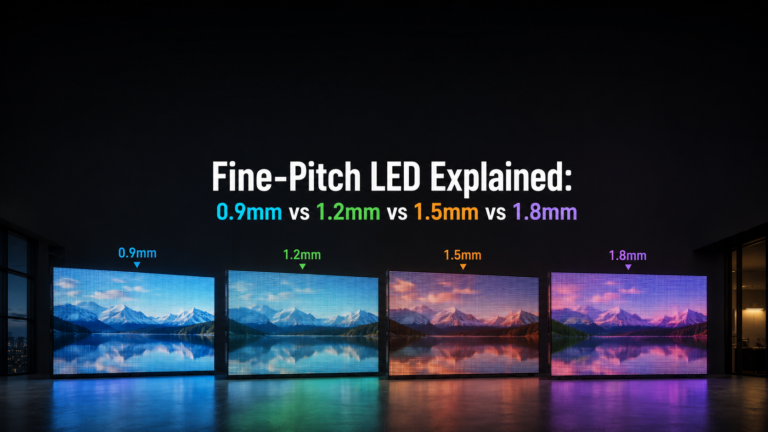
0.9mm, 1.2mm, 1.5mm, 1.8mm or larger?
3. Content
Will the display show:
- Text
- Presentations
- Video
- Camera feeds
- Graphics
- Digital signage
4. Environment
Is the display being installed indoors or outdoors?
5. Brightness
How much ambient light is present?
6. Serviceability
How easily can modules or components be replaced?
7. Budget
What is the customer’s investment level?
Simple Example
Imagine a premium boardroom where participants sit approximately 2 meters from the LED wall.
The customer wants:
- Very sharp images
- Fine text
- High-quality video
- Premium appearance
A fine-pitch COB LED solution could be a strong option.
Now consider a large conference hall where the audience is 10 meters away.
A good-quality SMD LED with an appropriate pixel pitch may provide excellent performance at a more practical cost.
The technology should therefore be selected based on the application rather than the specification alone.
SMD, COB or MicroLED: Which Should You Choose?
SMD LED
Best for:
General professional AV + cost efficiency + wide availability
COB LED
Best for:
Premium indoor AV + fine pixel pitch + close viewing
MicroLED
Best for:
Advanced premium applications + extremely high display performance
Final Verdict
SMD, COB and MicroLED are different approaches to building LED displays.
The simple difference is:
SMD uses surface-mounted LED components. COB places LED chips directly on the board. MicroLED uses extremely small LED chips for advanced high-density displays.
For most professional AV projects:
SMD offers a proven and cost-effective solution.
COB is attractive for premium fine-pitch applications.
MicroLED represents a more advanced and premium display technology.
The best choice depends on:
Viewing Distance + Pixel Pitch + Content + Brightness + Environment + Serviceability + Budget
Don’t choose an LED wall simply because one technology sounds more advanced. Choose the technology that provides the right performance for the actual application.
Frequently Asked Questions
What is SMD LED?
SMD stands for Surface-Mount Device. It uses packaged LED components mounted on the surface of a circuit board.
What is COB LED?
COB stands for Chip-on-Board. LED chips are mounted directly onto the circuit board and covered with a protective layer.
What is MicroLED?
MicroLED is an advanced display technology that uses extremely small individual LED chips to create very high-density displays.
Is COB better than SMD?
Not always. COB can provide advantages for fine-pitch and premium indoor applications, while SMD can offer greater product availability, easier servicing and cost advantages.
Is MicroLED better than COB?
MicroLED can provide advanced display performance, but it is generally more expensive and is not necessary for every AV application.
Which LED technology is best for a meeting room?
For a premium meeting room, both SMD and COB can be suitable. The decision should consider pixel pitch, viewing distance, screen size, content and budget.
Related AV Insider Guides
Continue learning about LED and professional AV:
- Fine-Pitch LED Explained: 0.9mm vs 1.2mm vs 1.5mm vs 1.8mm
- LED Wall vs Projector: Which Is Better?
- What Is a Video Wall?
- What Is AV? Complete Guide to Audiovisual Technology
- AV System Design Guide
- What Is AV Over IP?