What Is Dante? How Does Dante Work in AV?
Dante is a professional audio networking technology that allows digital audio to travel through an Ethernet network.
It is widely used in meeting rooms, conference halls, auditoriums, theatres, broadcast studios and professional AV systems.
In simple terms, Dante allows audio devices to communicate through a network instead of using separate audio cables for every connection.
How Does Dante Work?
The basic idea is simple:
Microphone → Network Switch → DSP → Amplifier → Speaker
A Dante microphone captures someone’s voice and converts it into digital audio. The audio then travels through the Ethernet network to the required Dante device.
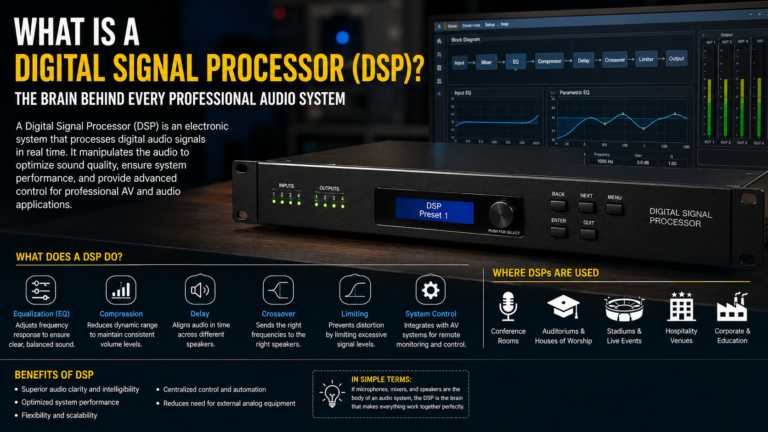
The DSP processes the audio, and the processed signal is sent to the amplifier and speakers.
Simple Example
Imagine a meeting room with four Dante microphones, one Dante DSP, one network switch, one Dante amplifier and four speakers.
When someone speaks, the audio travels through the network from the microphone to the DSP, then to the amplifier and finally to the speakers.
Dante Microphone → Network Switch → Dante DSP → Dante Amplifier → Speakers
This means the system can transport multiple audio channels through the network without requiring a separate point-to-point audio cable for every connection.
What Is Dante Controller?
Dante Controller is software used to discover Dante devices and create audio connections.
For example:
Microphone 1 → DSP Input 1
DSP Output 1 → Amplifier Channel 1
These connections can be changed through software instead of physically changing cables.
Does Dante Need the Internet?
No.
Dante can work on a local network without Internet access.
For example, the microphone, network switch, DSP and amplifier can all communicate within the local AV network.
Why Is Dante Useful?
Dante makes professional audio systems:
- More flexible
- Easier to route
- Easier to expand
- Easier to manage
- Less dependent on point-to-point audio cabling
It is especially useful when a system has many microphones, DSPs, amplifiers and other audio devices.
Dante vs Traditional Audio
A traditional system may use:
Microphone → XLR Cable → DSP
A Dante system can use:
Microphone → Ethernet Network → DSP
The main difference is that Dante uses the network to transport digital audio.
Where Is Dante Used?
Dante is commonly used in:
Corporate: Meeting rooms and boardrooms
Education: Classrooms and lecture halls
Events: Conferences, theatres and live events
Broadcast: Studios and production environments
Hospitality: Hotels, ballrooms and event spaces
The Easy Way to Remember Dante
Think of Dante as a digital audio highway.
The Ethernet network provides the path, while Dante allows compatible AV devices to send and receive digital audio across that network.
Dante = Digital audio transported through a network.
As AV systems become increasingly connected to IT networks, understanding Dante is an important skill for modern AV engineers and technicians.
Frequently Asked Questions
What is Dante in AV?
Dante is a technology that allows digital audio to travel between compatible professional AV devices over an Ethernet network.
Does Dante need the Internet?
No. Dante can operate on a local network without Internet access.
What is Dante Controller?
Dante Controller is software used to discover Dante devices, create audio connections and monitor the Dante network.
Does Dante use Ethernet cables?
Yes. Dante uses Ethernet network infrastructure such as Cat5e, Cat6, Cat6A and fiber, depending on the system.
Is Dante better than analog audio?
Dante is particularly useful for larger and more flexible systems, but analog audio can still be a good choice for simple systems. The right technology depends on the project requirements.
Can Dante carry video?
Dante is best known for networked audio. Dante AV technologies also support networked video for compatible products.
Related AV Insider Guides
What Is AV? Complete Guide to Audiovisual Technology
What Is AV Over IP? Complete Guide
What Is DSP in AV?
What Is AEC? Acoustic Echo Cancellation Explained
What Is NDI? Complete Guide
Dante vs AES67: What’s the Difference?
Managed vs Unmanaged Network Switches for AV