What Is AV? Complete Guide to Audiovisual Technology, AV Systems, Companies, Jobs & the AV Industry
AV is everywhere.
You can find AV technology in meeting rooms, classrooms, boardrooms, conference halls, cinemas, stadiums, airports, museums, retail stores, broadcast studios, control rooms, houses of worship, hotels and live events.
But what exactly does AV mean?
What is the full form of AV? What does an AV company do? What is an AV integrator? What jobs are available in AV? What is an AV room? And how can someone start a career in the AV industry?
This complete guide explains AV, or audiovisual technology, from the basics to the professional AV industry.
What Does AV Mean?
AV means Audiovisual.
The term combines two fundamental forms of communication:
- Audio — sound, speech, music and other audible information
- Visual — images, video, graphics and other visual information
An AV system combines technologies that allow people to create, process, distribute, display, hear, control and interact with audio and visual information.
In professional environments, AV is much more than a television, projector or microphone.
A modern AV system can include:
- Microphones
- Speakers
- Amplifiers
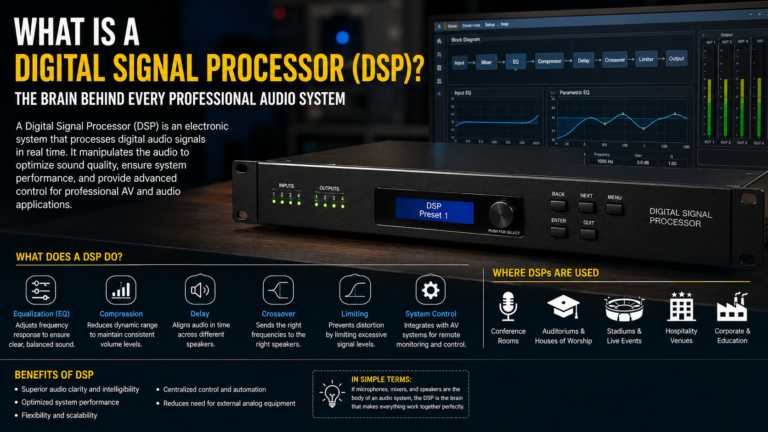
- Digital Signal Processors (DSP)
- Cameras
- Displays
- Projectors
- LED walls
- Video processors
- Matrix switchers
- AV over IP systems
- Control systems
- Video conferencing systems
- Digital signage
- Streaming systems
- Network switches
- Structured cabling
- Collaboration platforms
Modern AV sits at the intersection of technology, content and physical space.
What Is the Full Form of AV?
The most common full form of AV is Audiovisual.
You may also see AV written as:
- AV
- A/V
- Audio Visual
- Audiovisual
- Pro AV
- Professional AV
In the professional technology industry, Pro AV generally refers to professional audiovisual systems designed for commercial, institutional, entertainment or specialized environments.
For example, a corporate meeting room with microphones, speakers, cameras, displays and a video conferencing system is a professional AV environment.
What Exactly Is AV?
AV is a technology ecosystem used to communicate information through sound, images, video and interactive experiences.
A simple audio system may look like:
Microphone → DSP → Amplifier → Speaker
A simple video system may look like:
Camera → Video Processing → Display
A complete meeting room could combine:
Microphone + Camera + Laptop + Network + DSP + Display + Speakers + Control System
The objective of AV is not simply to connect equipment.
The real objective is to create a system that allows people to:
- Communicate
- Collaborate
- Present
- Learn
- Share information
- Entertain
- Monitor
- Interact
This is why professional AV involves engineering, networking, acoustics, control, software, content and user experience.
What Does “AV Video” Mean?
The phrase “AV video” is commonly used when people search for audiovisual video technology.
Technically, the phrase is somewhat repetitive because AV already means Audiovisual.
However, in practical usage, AV video can refer to:
- Video signals
- Video distribution
- Video conferencing
- Camera systems
- PTZ cameras
- Video switching
- Video processing
- Video walls
- Displays
- HDMI systems
- SDI systems
- NDI systems
- AV over IP
- Digital signage
For example:
Camera → HDMI/SDI/NDI → Switcher → Processor → Display
In professional AV, video is usually only one part of the overall system. Audio, control, networking and user experience are equally important.
What Is an AV System?
An AV system is a combination of audiovisual equipment, software, infrastructure and control technologies designed to achieve a specific communication, collaboration, learning, entertainment or operational objective.
Example: Corporate Meeting Room
A modern meeting-room AV system may contain:
| System | Example |
|---|---|
| Camera | PTZ camera |
| Microphone | Ceiling microphone |
| Audio processing | DSP |
| Speaker | Ceiling speaker |
| Display | Professional display |
| Video | HDMI / USB / Network video |
| Collaboration | Microsoft Teams / Zoom |
| Control | Touch panel |
| Network | Managed Ethernet switch |
| Cabling | HDMI / USB / CAT / Fiber |
The equipment is only part of the solution.
An AV engineer must make sure all components communicate correctly and that the complete system works reliably.
What Does “AV Room” Mean?
An AV room is a room equipped with audiovisual technology for communication, presentation, collaboration, learning, entertainment, monitoring or specialized operations.
An AV room can be:
- Meeting room
- Conference room
- Boardroom
- Training room
- Classroom
- Auditorium
- Control room
- Command center
- Video conference room
- Broadcast studio
- Recording studio
- Experience center
- Screening room
The AV system installed in the room depends on the room’s purpose, size, number of users and required functionality.
What Is an AV Room Used For?
Corporate AV Rooms
AV rooms in corporate environments are commonly used for:
- Board meetings
- Video conferences
- Executive meetings
- Presentations
- Training
- Hybrid meetings
- Collaboration
A modern corporate room may integrate Microsoft Teams Rooms, Zoom Rooms, cameras, microphones, DSP, speakers, displays and room control.
Education AV Rooms
Educational AV systems are used in:
- Classrooms
- Lecture halls
- Training rooms
- Smart classrooms
- Distance learning
- Lecture recording
- Campus-wide AV distribution
Government AV Rooms
Government and specialized environments can use AV for:
- Command centers
- Control rooms
- Council chambers
- Situation rooms
- Secure collaboration
- Monitoring
- Visualization
Entertainment AV Rooms
AV technology is also used in:
- Cinemas
- Museums
- Theme parks
- Immersive experiences
- Live events
- Experience centers
What Is AV in a TV?
On a television, AV commonly refers to an Audio/Video input.
Traditional AV connections generally use analog audio and video signals.
The familiar composite AV connectors are:
- Yellow — Composite video
- Red — Right audio
- White — Left audio
Modern televisions increasingly use HDMI, USB and network connections, but the term AV input is still commonly found on TVs and other consumer devices.
AV vs HDMI
| Feature | AV | HDMI |
|---|---|---|
| Signal | Usually analog | Digital |
| Technology | Older | Modern |
| Audio | Separate connections | Audio + video |
| Video | Lower capability | High-resolution formats |
| Typical use | Legacy equipment | Modern equipment |
What Is AV Content?
AV content means content that communicates information through audio, video or both.
Examples include:
- Videos
- Presentations
- Training material
- Digital signage
- Recorded meetings
- Live streams
- Corporate communications
- Movies
- Music videos
- Educational content
- Interactive media
- Immersive content
A simple way to understand it is:
Content = the message
AV system = the technology used to deliver the message
For example:
Content: Company presentation
AV system: Laptop + HDMI + Display + Speakers + Microphone
What Is an AV Show?
An AV show is an exhibition, demonstration or industry event focused on audiovisual technologies and solutions.
Professional AV shows bring together:
- AV manufacturers
- Systems integrators
- Consultants
- Distributors
- Dealers
- AV engineers
- Technology managers
- End users
- AV professionals
Products and technologies demonstrated at AV exhibitions can include:
- Displays
- LED walls
- Projectors
- Cameras
- Microphones
- Speakers
- DSPs
- Amplifiers
- Video processors
- AV over IP
- Control systems
- Digital signage
- Streaming
- Collaboration technology
AV exhibitions are also useful for networking, training, product discovery and understanding new industry trends.
What Is AV Cinema?
AV cinema refers to the audiovisual technology used in a cinema or movie theatre.
A professional cinema AV system can include:
- Cinema projector
- Digital cinema server
- Cinema processor
- Amplifiers
- Surround speakers
- Subwoofers
- Projection screen
- Automation system
- Acoustic treatment
- Lighting control
- Monitoring systems
The goal is to create a synchronized and immersive visual and audio experience for the audience.
Modern cinema technology can include advanced projection, laser projection, large-format displays and immersive audio systems.
What Is an AV Business?
An AV business is a company that sells, designs, installs, integrates, manufactures, rents, supports or manages audiovisual technology.
There are several types of AV businesses.
1. AV Manufacturers
AV manufacturers design and manufacture products such as:
- Displays
- Projectors
- Cameras
- Microphones
- Speakers
- DSPs
- Amplifiers
- Switchers
- Control systems
2. AV Integrators
An AV integrator designs and combines multiple products into a complete working system.
For example:
Display + Camera + Microphone + DSP + Speakers + Control + Network
The integrator makes these technologies work together.
3. AV Dealers and Distributors
AV dealers and distributors supply equipment to:
- Integrators
- Resellers
- Consultants
- End customers
4. AV Rental and Staging Companies
These companies provide temporary AV equipment and technical services for:
- Conferences
- Exhibitions
- Corporate events
- Concerts
- Product launches
- Live shows
5. AV Consultants
AV consultants provide:
- System design
- Technical specifications
- Consultancy
- Project planning
- Technology recommendations
6. AV Service Companies
AV service companies provide:
- Maintenance
- Troubleshooting
- Remote support
- Preventive maintenance
- Device monitoring
- Break/fix support
- Lifecycle management
What Are AV Companies?
AV companies are organizations involved in the audiovisual industry.
The AV industry includes many different types of organizations:
- AV manufacturers
- AV integrators
- AV consultants
- AV distributors
- AV dealers
- AV rental companies
- AV service providers
- Broadcast companies
- Digital signage companies
- Collaboration technology companies
- Event production companies
This means the AV industry is much larger than simply companies that manufacture speakers, projectors or displays.
Who Is the Biggest AV Company?
There is no single universally accepted answer to the question “Who is the biggest AV company?”
The answer depends on what you are measuring.
For example:
- Revenue
- Number of employees
- Global presence
- AV installation revenue
- Manufacturing revenue
- Number of customers
- Number of locations
If we specifically talk about commercial AV systems integration, industry rankings provide a better benchmark.
SCN’s 2025 Top 50 Systems Integrators ranking placed AVI-SPL at #1, followed by Diversified, FORTÉ, Ricoh and EOS IT Solutions.
Therefore, a more accurate answer is:
AVI-SPL is one of the world’s largest professional AV systems integrators and ranked #1 in SCN’s 2025 Top 50 Systems Integrators ranking.
It is better to give this qualified answer rather than simply claiming that one company is “the biggest AV company.”
Who Are the Top AV Integrators in the US?
AV integrator rankings can change every year, and different organizations use different methodologies.
One important industry benchmark is the SCN Top 50 Systems Integrators ranking.
Leading companies appearing in recent rankings include:
- AVI-SPL
- Diversified
- FORTÉ
- Ricoh
- EOS IT Solutions
- Yorktel-Kinly
- Pavion
- Avidex
- Solutionz
- Ford AV
Other regional and specialist AV integrators are also significant in the US market.
The biggest company is not necessarily the best company for every project.
For example, a customer looking for a control-room solution may need a different integrator than a customer looking for a Microsoft Teams meeting-room deployment.
When selecting an AV integrator, consider:
- Project experience
- Technical expertise
- Certifications
- Manufacturer partnerships
- Geographic coverage
- Service capability
- Project management
- Support capability
- Previous installations
How Many AV Companies Are There?
There is no authoritative worldwide count of all AV companies.
The reason is that the AV industry is extremely broad.
It includes:
- Manufacturers
- Integrators
- Consultants
- Dealers
- Distributors
- Rental companies
- Event production companies
- Service providers
- Content producers
- Broadcast companies
- Digital signage providers
- Collaboration specialists
Therefore, it would be misleading to say:
“There are exactly X AV companies in the world.”
A better answer is:
There are thousands of organizations participating in the global professional AV ecosystem, but there is no single authoritative database that counts every AV company worldwide.
Which Jobs Are in AV?
The AV industry offers many different career paths.
You do not need to be an electronics engineer to build a career in AV.
Technical AV Jobs
- AV Technician
- AV Engineer
- AV Support Engineer
- AV Field Engineer
- AV Commissioning Engineer
- AV Installation Technician
- AV Service Engineer
- AV Network Engineer
- Control System Programmer
- DSP Programmer
- Video Engineer
- Audio Engineer
AV Design and Engineering Jobs
- AV Design Engineer
- AV Consultant
- AV Systems Designer
- AV Project Engineer
- AV Solutions Architect
- AV/IT Engineer
- Acoustics Consultant
AV Management Jobs
- AV Project Manager
- AV Operations Manager
- AV Technical Manager
- AV Service Manager
- AV Program Manager
- AV Department Manager
AV Sales and Presales Jobs
- AV Sales Engineer
- AV Presales Engineer
- Solutions Consultant
- Business Development Manager
- AV Account Manager
- AV Product Specialist
Live Event AV Jobs
- Audio Technician
- Video Technician
- Lighting Technician
- Live Production Engineer
- Technical Director
- Event Production Manager
The AV industry therefore provides opportunities in engineering, networking, programming, sales, project management, consulting, events and operations.
How to Join the AV Industry
If you are interested in starting a career in AV, follow a structured learning path.
Step 1: Learn AV Fundamentals
Start with:
- Audio fundamentals
- Video fundamentals
- Signal flow
- Connectors
- Cables
- HDMI
- USB
- Ethernet
- Displays
- Projectors
- Microphones
- Speakers
- Amplifiers
- DSP
Step 2: Understand Signal Flow
Signal flow is one of the most important concepts in AV.
Start with simple systems.
Audio
Microphone → DSP → Amplifier → Speaker
Video
Laptop → HDMI → Switcher → Display
Once you understand signal flow, troubleshooting becomes much easier.
Step 3: Learn Networking
Modern AV is increasingly network-based.
Important networking concepts include:
- IP addressing
- DHCP
- DNS
- VLANs
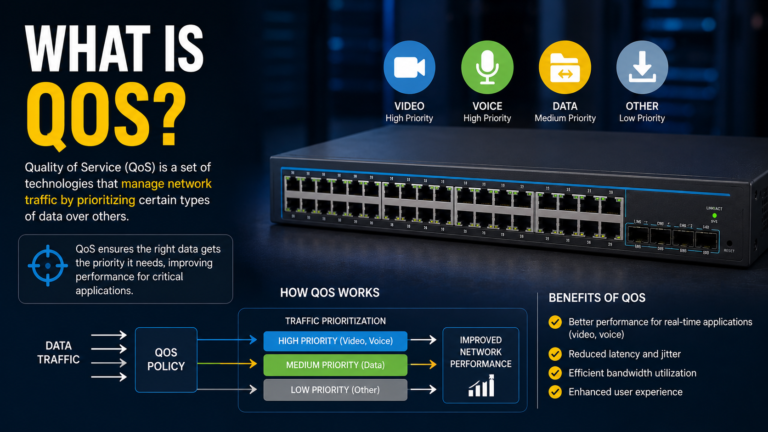
- QoS
- Multicast
- PoE
- IGMP
- Managed switches
- Network troubleshooting
Networking knowledge is especially important for:
- AV over IP
- Dante
- NDI
- Networked DSP
- Control systems
- Microsoft Teams Rooms
Step 4: Learn Major AV Technologies
Depending on your career path, learn technologies such as:
- Dante
- Q-SYS
- Crestron
- Extron
- Biamp
- Shure
- Microsoft Teams Rooms
- Zoom Rooms
- NDI
- AV over IP
You do not need to master everything at once.
Start with fundamentals and specialize later.
Step 5: Get Practical Experience
Hands-on experience is extremely valuable in AV.
Start with small systems.
For example:
Laptop → HDMI Switch → Display
Then:
Microphone → DSP → Amplifier → Speaker
Then:
Camera + Microphone + Speaker + Display + Teams/Zoom
Practice:
- Installation
- Configuration
- Troubleshooting
- Testing
- Signal tracing
- Documentation
Step 6: Consider AV Certifications
Professional training and certifications can help structure your learning.
Examples include training related to:
- AVIXA
- Dante
- Q-SYS
- Crestron
- Extron
- Biamp
- Shure
- Microsoft Teams Rooms
- Zoom
Certifications are useful, but hands-on experience + troubleshooting ability + system understanding are equally important.
What Skills Does an AV Engineer Need?
A modern AV engineer needs more than hardware knowledge.
Technical Skills
- Audio
- Video
- Networking
- DSP
- Control systems
- Signal distribution
- Troubleshooting
- System commissioning
Communication Skills
- Customer communication
- Technical documentation
- Presentation
- Technical explanation
- Problem solving
Project Skills
- BOQ preparation
- System design
- Site surveys
- Drawings
- Testing
- Commissioning
- Handover documentation
The strongest AV professionals understand both technology and people.
What Does an AV Integrator Do?
An AV integrator combines multiple technologies into one complete working solution.
Imagine a customer says:
“I need a 20-seat hybrid meeting room.”
The customer does not want to purchase ten different products and figure out how to connect everything.
The AV integrator designs the complete system.
For example:
Microphones
↓
DSP / AEC
↓
USB / Network
↓
Microsoft Teams / Zoom
↓
Camera
↓
Display
↓
Speakers
The integrator may also provide:
- Site survey
- System design
- BOQ
- Equipment selection
- Procurement
- Installation
- Programming
- Configuration
- Testing
- Commissioning
- Training
- Documentation
- Maintenance
The key point:
An AV integrator does not simply sell equipment. The integrator makes different technologies work together as one complete system.
AV Manufacturer vs AV Integrator
These two terms are often confused.
| Manufacturer | Integrator |
|---|---|
| Creates equipment | Creates complete systems |
| Develops products | Selects products |
| Manufactures hardware/software | Installs and configures |
| Provides product support | Provides project/service support |
| Focuses on individual products | Focuses on complete solutions |
A single AV project can use products from many manufacturers, while one systems integrator may be responsible for delivering the complete solution.
AV vs IT
Modern AV and IT are increasingly connected.
Traditional AV
Traditional AV systems commonly used:
- HDMI
- XLR
- Analog audio
- Projectors
- Speakers
- Video switchers
- Dedicated control connections
Modern AV
Modern AV increasingly uses:
- IP video
- Dante
- NDI
- AV over IP
- Cloud management
- Networked DSP
- USB
- Teams Rooms
- Remote monitoring
- Software-based control
This means AV professionals increasingly need IT and networking skills.
A modern AV engineer may work across:
AV + IT + Networking + Software + Cloud + Security
Why Is Networking Important in AV?
Many modern AV systems use Ethernet networks to transport:
- Audio
- Video
- Control
- Device management
- Monitoring
- Conferencing traffic
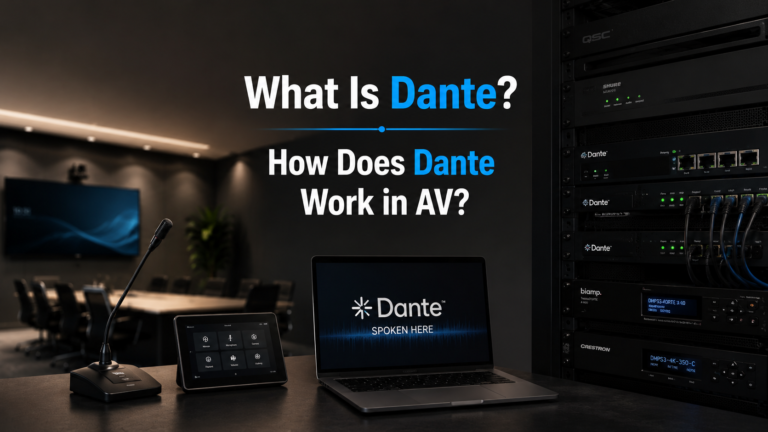
For example, Dante can distribute audio between microphones, DSPs, amplifiers and other networked devices.
AV over IP systems can distribute video across an Ethernet network.
Modern meeting rooms can also use Ethernet for:
- Cameras
- Touch panels
- DSPs
- Displays
- Control processors
- Networked audio devices
This is why AV and IT are becoming increasingly interconnected.
What Is Professional AV?
Professional AV, often called Pro AV, refers to audiovisual technology designed for professional environments.
Examples include:
- Corporate AV
- Education AV
- Healthcare AV
- Government AV
- Hospitality AV
- Retail AV
- Broadcast AV
- Live events
- Sports venues
- Museums
- Entertainment
- Control rooms
Professional AV systems generally place greater emphasis on:
- Reliability
- Scalability
- Integration
- Manageability
- Serviceability
- Security
- Performance
- User experience
What Is an AV Control System?
An AV control system allows users to control multiple AV devices from a single interface.
For example, a touchscreen can control:
- Display power
- Source selection
- Volume
- Camera
- Lighting
- Curtains
- Video conferencing
- Room modes
Instead of operating several different remotes, the user can press:
START MEETING
The system can automatically:
- Turn on the display
- Start the conferencing system
- Select the camera
- Configure the microphone
- Set the audio level
- Select the correct input
- Set the room mode
This is where AV becomes an integrated user experience rather than a collection of individual devices.
What Is AV Over IP?
AV over IP means transporting audiovisual signals over an IP network.
A traditional AV system may look like:
Source → HDMI Cable → Display
An AV over IP system may look like:
Source → Encoder → Network → Decoder → Display
AV over IP can provide:
- Scalability
- Flexible routing
- Long-distance distribution
- Centralized management
- Multi-room distribution
- Network-based monitoring
AV over IP is one of the major areas where AV and IT converge.
Where Is AV Used?
AV technology is used in almost every major industry.
Corporate
- Meeting rooms
- Boardrooms
- Training rooms
- Executive briefing centers
- Collaboration spaces
Education
- Classrooms
- Lecture halls
- Training centers
- Universities
- Distance learning
Healthcare
- Patient education
- Digital signage
- Collaboration
- Visualization
- Training
Government
- Command centers
- Control rooms
- Council chambers
- Situation rooms
Hospitality
- Hotels
- Conference centers
- Banquet halls
- Event spaces
Retail
- Digital signage
- Interactive displays
- Customer experiences
Entertainment
- Cinemas
- Museums
- Theme parks
- Immersive installations
Sports
- Stadium displays
- Scoreboards
- Control rooms
- Fan engagement systems
Live Events
- Conferences
- Concerts
- Exhibitions
- Product launches
- Corporate events
Is AV a Good Career?
Yes. AV can be a strong technology career path.
The industry provides opportunities across:
- Engineering
- Networking
- Programming
- Project management
- Sales
- Presales
- Consulting
- Events
- Operations
- Technical support
AV is also changing rapidly.
Modern AV professionals increasingly work with:
- IP networks
- Cloud management
- AI
- Automation
- Collaboration platforms
- Digital signage
- AV over IP
- Remote monitoring
- Intelligent buildings
- Software-defined AV
This means the AV professional of the future will need to understand both AV technology and IT technology.
Is AV the Same as Home Theatre?
No.
Home theatre is one application of audiovisual technology.
Professional AV is much broader.
| Home AV | Professional AV |
|---|---|
| Homes | Corporate environments |
| Personal entertainment | Communication and collaboration |
| Movies and music | Meetings and presentations |
| Gaming | Education and training |
| Usually small-scale | Can range from one room to large campuses |
| User-operated | Often centrally managed |
Home theatre is therefore a part of the broader audiovisual industry.
AV Glossary: Important AV Terms
| Term | Meaning |
|---|---|
| AV | Audiovisual |
| Pro AV | Professional Audiovisual |
| DSP | Digital Signal Processor |
| AEC | Acoustic Echo Cancellation |
| AV over IP | Audio/Video over IP |
| Dante | Networked audio technology |
| NDI | Network Device Interface |
| HDMI | High-Definition Multimedia Interface |
| SDI | Serial Digital Interface |
| PTZ | Pan, Tilt and Zoom |
| PoE | Power over Ethernet |
| QoS | Quality of Service |
| VLAN | Virtual Local Area Network |
| EDID | Extended Display Identification Data |
| CEC | Consumer Electronics Control |
| UC | Unified Communications |
| MTR | Microsoft Teams Rooms |
| LED | Light-Emitting Diode |
| AV Matrix | Device used to route multiple sources to multiple destinations |
| AV Integrator | Company that designs and implements complete AV systems |
Frequently Asked Questions About AV
What does AV stand for?
AV stands for Audiovisual.
What is AV?
AV is the technology, systems and expertise used to communicate, collaborate and create experiences through sound, video, displays, cameras, control, networking and interactive media.
What is AV video?
AV video generally refers to the video side of audiovisual technology, including cameras, video processing, switching, distribution, conferencing and displays.
What is an AV room?
An AV room is a room equipped with audiovisual technology for meetings, presentations, collaboration, learning, entertainment or specialized operations.
What is an AV company?
An AV company can manufacture, sell, design, integrate, install, rent, support or manage audiovisual technology.
Who is the biggest AV company?
There is no universal answer because the definition of “biggest” varies. For commercial AV systems integration, AVI-SPL ranked #1 in SCN’s 2025 Top 50 Systems Integrators ranking.
How many AV companies are there?
There is no authoritative global count. The industry consists of thousands of organizations across manufacturing, integration, consulting, distribution, rental, events, content and services.
What is an AV business?
An AV business is a company involved in the design, manufacture, sale, integration, rental, installation or support of audiovisual technology.
Which jobs are AV jobs?
AV jobs include AV technician, AV engineer, AV designer, AV consultant, AV programmer, DSP programmer, AV project manager, AV sales engineer, AV presales engineer, AV service engineer and AV technical manager.
How can I join the AV industry?
Start by learning audio, video, signal flow, cabling and networking. Then gain hands-on experience and specialize in technologies such as Dante, Q-SYS, Crestron, Extron, Biamp, Teams Rooms, Zoom Rooms, NDI or AV over IP.
What is AV content?
AV content is audio, video or multimedia content created for communication, entertainment, education, advertising, collaboration or other experiences.
What is an AV show?
An AV show is an exhibition or event where audiovisual technologies, solutions and services are demonstrated to AV professionals and end users.
What is AV in a TV?
On a television, AV usually refers to an Audio/Video input, traditionally associated with analog composite video and stereo audio connections.
What is AV cinema?
AV cinema refers to the audiovisual systems used in cinemas, including projection or display, cinema audio, processing, amplification, speakers and associated control systems.
What is an AV integrator?
An AV integrator designs, installs, programs, configures and supports complete audiovisual systems using products from multiple manufacturers.
The Future of AV
The AV industry is moving from isolated hardware toward connected, intelligent and software-driven environments.
Several major trends are shaping the future of AV.
1. AV Over IP
More audio and video systems are moving onto standard network infrastructure.
2. Artificial Intelligence
AI is increasingly being used for:
- Camera tracking
- Speech recognition
- Meeting transcription
- Room automation
- Device diagnostics
- Content workflows
3. Cloud Management
AV devices can increasingly be monitored and managed remotely.
4. Hybrid Collaboration
Microsoft Teams, Zoom and other collaboration platforms continue to influence meeting-room design.
5. Intelligent Buildings
AV systems are increasingly being connected with:
- Lighting
- HVAC
- Room booking
- Building management
- Occupancy systems
6. Software-Defined AV
More AV functionality is moving into software, network infrastructure and centralized management.
The future AV professional will increasingly need knowledge across AV, IT, networking, software and cloud technologies.
Final Answer: What Is AV?
If you remember only one definition, remember this:
AV means Audiovisual. It is the technology, systems and expertise used to communicate, collaborate and create experiences through sound, video, displays, cameras, control, networking and interactive media.
AV is much bigger than microphones, speakers and projectors.
It includes:
Audio + Video + Displays + Cameras + Conferencing + DSP + Networking + Control + Digital Signage + Streaming + Broadcast + Immersive Technology
And behind all of these systems are professionals such as:
AV Technicians + AV Engineers + Designers + Consultants + Integrators + Programmers + Project Managers + Presales Engineers + Technical Managers
That is why AV has become an important intersection between technology, communication, IT and human experience.
If you are interested in building a career in technology, AV is no longer just about cables and hardware.
Modern AV is becoming a highly connected technology discipline involving:
Networking + Software + Cloud + AI + Automation + Intelligent Environments
Start Your AV Journey
If you are new to audiovisual technology, explore these topics next:
- What Is AV Over IP?
- What Is Dante?
- What Is a DSP?
- What Is AEC?
- What Is a PTZ Camera?
- What Is a Video Wall?
- What Is HDMI?
- What Is NDI?
- What Is a Matrix Switcher?
- What Is an AV Rack?
- What Is a Teams Room?
- How to Become an AV Engineer
- Best AV Certifications for Beginners
- AV System Design Basics
- How to Prepare an AV BOQ
- AV Network Design
- AV Signal Flow Explained
Welcome to the world of AV. 🎥🎙️🌐
AV Insider — Practical guides for audiovisual technology, AV engineering, systems integration and modern workplace technology.
If you are interested in learning more about audiovisual technology, explore these detailed AV guides from AV Insider:
🌐 AV Over IP
Modern AV systems are increasingly moving from traditional point-to-point connections to IP-based distribution. Learn how AV over IP works and why it is changing professional AV systems.
👉 Why AV-over-IP Is Transforming Enterprise AV
🔀 AV Over IP vs Matrix Switching
Not sure whether to use a traditional matrix switcher or an AV-over-IP architecture? This guide explains the differences between the two approaches.
👉 AV-over-IP vs Traditional Matrix Switching: Which One Should You Choose?
🎙️ Acoustic Echo Cancellation (AEC)
AEC is one of the most important technologies in modern meeting rooms. Learn how acoustic echo cancellation works and why it is essential for clear conferencing audio.
👉 How Acoustic Echo Cancellation (AEC) Works in AV Systems
🎥 NDI
NDI allows video devices and production systems to communicate over IP networks. It is increasingly used in AV, streaming, production and broadcast workflows.
👉 What Is NDI and How Does It Work?
🎧 Dante vs AES67
Networked audio is an important part of modern AV. Learn how Dante and AES67 compare and where each technology fits into professional AV systems.
👉 Dante vs AES67: What’s the Difference?
🖥️ Microsoft Teams Rooms vs Zoom Rooms
Modern AV meeting rooms increasingly integrate unified communications platforms. Compare Teams Rooms and Zoom Rooms and understand how they fit into meeting-room AV.
👉 Microsoft Teams Rooms vs Zoom Rooms: Which Platform Should Organizations Choose?
🌐 Managed vs Unmanaged Network Switches
Networking is becoming increasingly important in professional AV. Learn why the choice between managed and unmanaged switches matters for AV systems.
👉 Managed vs Unmanaged Switches: Which One Is Better for AV Systems?
🤖 AI Cameras in Meeting Rooms
AI-powered cameras are changing the way modern meeting rooms track speakers, frame participants and improve hybrid collaboration.
👉 AI Cameras in Meeting Rooms: The Future of Smart Collaboration
🎓 AV Certifications
If you’re interested in building a career in AV, certifications can help validate your technical knowledge and improve your professional development.
👉 Top 10 AV Certifications Every Professional Should Consider
The professional AV industry brings together content, technology and physical space. Learn more about the AV industry from AVIXA.